
Tenant improvement HVAC costs make more sense when you split them into parts. Instead of one big number, think of a stack of separate pieces: ductwork, rooftop units, controls, labor, crane time, permits, and testing. Each piece has its own drivers, and each one can be trimmed or upgraded on its own. This guide walks through every part of a typical HVAC scope and explains what pushes its cost up or down.
Owners, tenants, and project managers can use this breakdown to read bids, compare options, and spot gaps.
Why Break Costs Into Parts?
At first, lump-sum bids seem easy to compare at a glance. Yet they hide details. One bid may include controls while another leaves them out. One may assume a curb adapter while another plans a new curb. Breaking tenant improvement HVAC costs into parts shows you exactly what you are paying for.
In addition, it helps you make trade-offs. For instance, you might reuse existing ductwork to fund better controls.
Part 1: Rooftop Units and Equipment
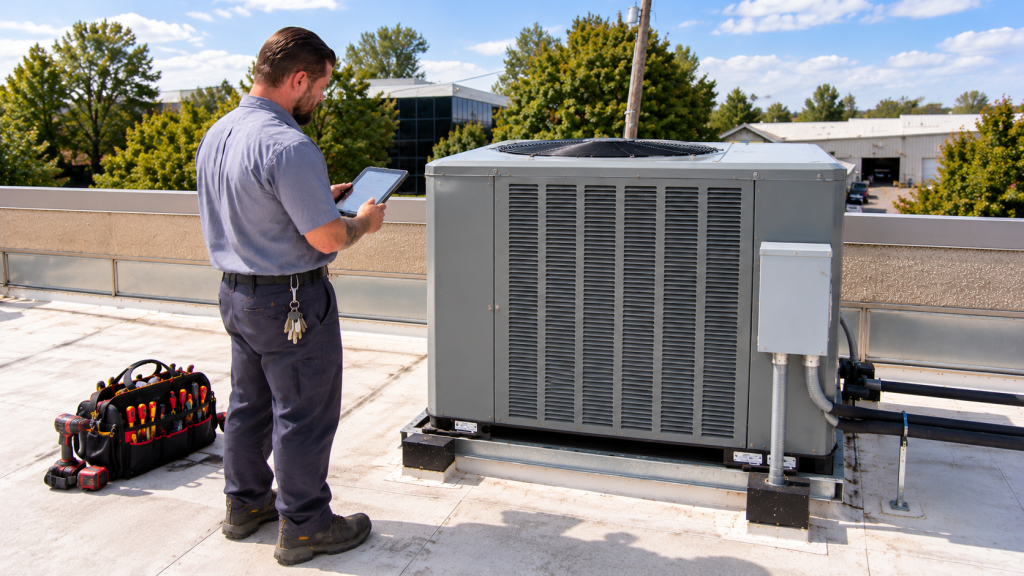
In most cases, equipment is the largest single line item. Price depends on:
- Capacity: Bigger units cost more.
- Efficiency: Higher-efficiency models cost more up front but save energy.
- Features: Economizers, variable speed fans, hail guards, and smoke detectors add cost.
- Heating type: Gas heat, heat pumps, and electric heat each have different prices.
- Refrigerant: Newer refrigerants may change pricing and technician needs.
Reusing healthy existing units can save a great deal. However, old units may cost more in repairs and energy over time. For more on that choice, read our guide to retrofit vs. replacement.
Part 2: Ductwork in Tenant Improvement HVAC Costs
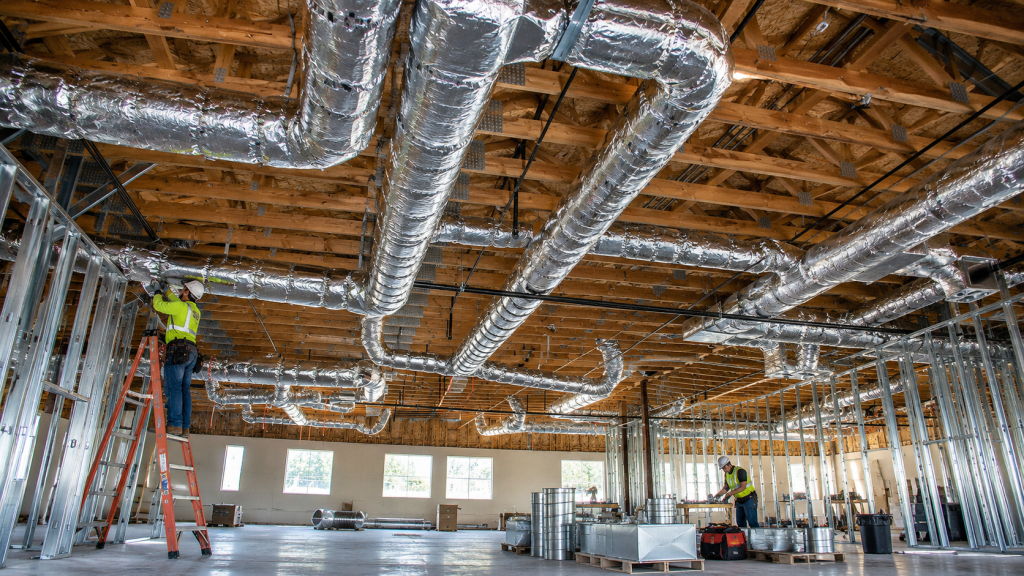
Next, ductwork costs depend on length, size, shape, and material. Rectangular duct is common in concealed ceilings. Spiral round duct is popular in open ceilings and often costs more because it is meant to look good.
Other duct cost drivers include:
- Insulation and sealing requirements
- Number of branches and fittings
- Fire and smoke dampers at rated walls
- Access doors and volume dampers
- Painting exposed duct
- Demolition of old ductwork
Reusing existing main trunks and changing only branches can cut tenant improvement HVAC costs a lot. Learn more on our ductwork contractor page.
Part 3: Air Distribution
Then diffusers, grilles, and registers deliver air to the room. Standard ceiling diffusers are affordable. Linear slot diffusers, decorative grilles, and specialty outlets cost more. The count matters too. More rooms and zones mean more outlets.
Part 4: Zoning Devices
Meanwhile, zoning lets different areas stay comfortable. Options range from simple zoning dampers to VAV boxes with reheat coils. VAV systems cost more but offer better comfort and efficiency in larger offices. In smaller suites, multiple single-zone units may be more affordable.
Part 5: Controls in Tenant Improvement HVAC Costs
Similarly, controls costs vary widely. A small shop with two smart thermostats spends little. An office with a full building automation system, sensors, graphics, and remote access spends much more. Integration with a landlord’s existing system can add cost and require specific brands.
Controls also carry hidden labor: programming, checkout, and owner training.
Part 6: Exhaust and Ventilation
Also, restrooms, break rooms, and janitor closets need exhaust fans. Specialty uses need more. Salons, labs, and kitchens may require dedicated exhaust systems. In addition, some codes require energy recovery or demand-controlled ventilation, which adds equipment.
Part 7: Labor in Tenant Improvement HVAC Costs
Of course, labor is a big part of tenant improvement HVAC costs. It depends on local wage rates, crew size, schedule, and site access. After-hours work in occupied buildings costs more. High-rise floors with limited elevator access take longer. Tight ceilings slow installation.
Part 8: Crane and Roof Work
Any rooftop swap or new unit means renting a crane. The price rises with weight, reach, and how tight the site is. Street permits and traffic control may add more. Roof work includes curbs, curb adapters, openings, and flashing. Many landlords require their own roofer for warranty reasons, which can affect price.

Part 9: Electrical Connections
Likewise, new or larger units need power. If the existing panel has room, the cost is modest. If the service needs an upgrade, the cost and schedule can jump. Always confirm electrical capacity early.
Part 10: Design, Permits, and Fees
Mechanical engineering fees, permit fees, and plan review fees add to the total. Some cities also require energy code testing or commissioning, which adds cost near the end.
Part 11: Testing and Balancing
Finally, balancing makes the system work as designed. A technician measures airflow at every outlet and adjusts it. Costs depend on the number of outlets and zones. Skipping this step saves little and often causes comfort problems later. See our testing and balancing page.
Putting It All Together
A typical breakdown might look like this, from largest to smallest share: equipment, ductwork, labor, controls, crane and roof work, air distribution, exhaust, balancing, and fees. Of course, the order shifts by project. A restaurant, for example, adds large kitchen exhaust and makeup air costs.
Ways to Trim Tenant Improvement HVAC Costs
- Reuse healthy rooftop units and main ducts.
- Choose standard diffusers in back-of-house areas.
- Right-size controls to the space.
- Plan crane lifts for multiple units in one day.
- Order equipment early to avoid rush charges.
How the Mix Changes by Use
The share of each part changes with the tenant. For a plain office, ducts and outlets take a big slice, since many rooms need air. A shop, by contrast, spends more on rooftop units for the sales floor. Restaurants are different again; kitchen exhaust and makeup air can take the largest share of all. So when you read a bid, think about which parts should be biggest for your use. If the numbers look off, ask why.
Reading Tenant Improvement HVAC Costs Line by Line
Good bids list each part with a price. They also list what is not included. For example, a bid may say “power by others” or “roof patch by landlord.” These notes matter a lot, because they shift cost to someone else. They tell you which costs will show up somewhere else. So line up all the bids side by side and fill in any gaps before you choose.
Where Money Is Best Spent
If the budget is tight, spend where it counts. Good equipment and good balancing make the biggest difference in comfort. Fancy outlets in back rooms do not. Likewise, smart controls often pay for themselves through lower bills. So put money into the parts people feel every day, and save on the parts nobody sees. That simple rule keeps tenant improvement HVAC costs in check without hurting comfort.
Common Bid Gaps
So watch for missing items such as curb adapters, electrical connections, fire dampers, controls programming, balancing, and permit fees. Ask each bidder to list inclusions and exclusions clearly.
FAQ on Tenant Improvement HVAC Costs
What is usually the largest part of tenant improvement HVAC costs?
Equipment, followed closely by ductwork and labor.
Can reusing ductwork really save money?
Yes, especially when the main trunks are in good shape and only branches need changes.
Get a Detailed Breakdown
Knowing each part helps you budget wisely. Visit our cost guide, or request an itemized quote. Duct standards from SMACNA often shape ductwork pricing.